.png)
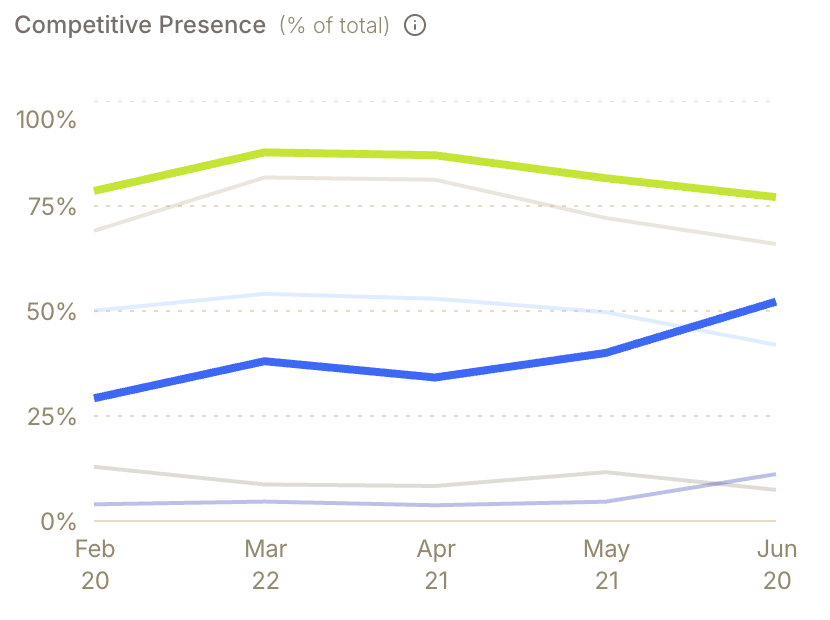
The Result: Over roughly four months, Zip's presence in AI answers grew 78% (relative) from about 29% of answers to 52%.
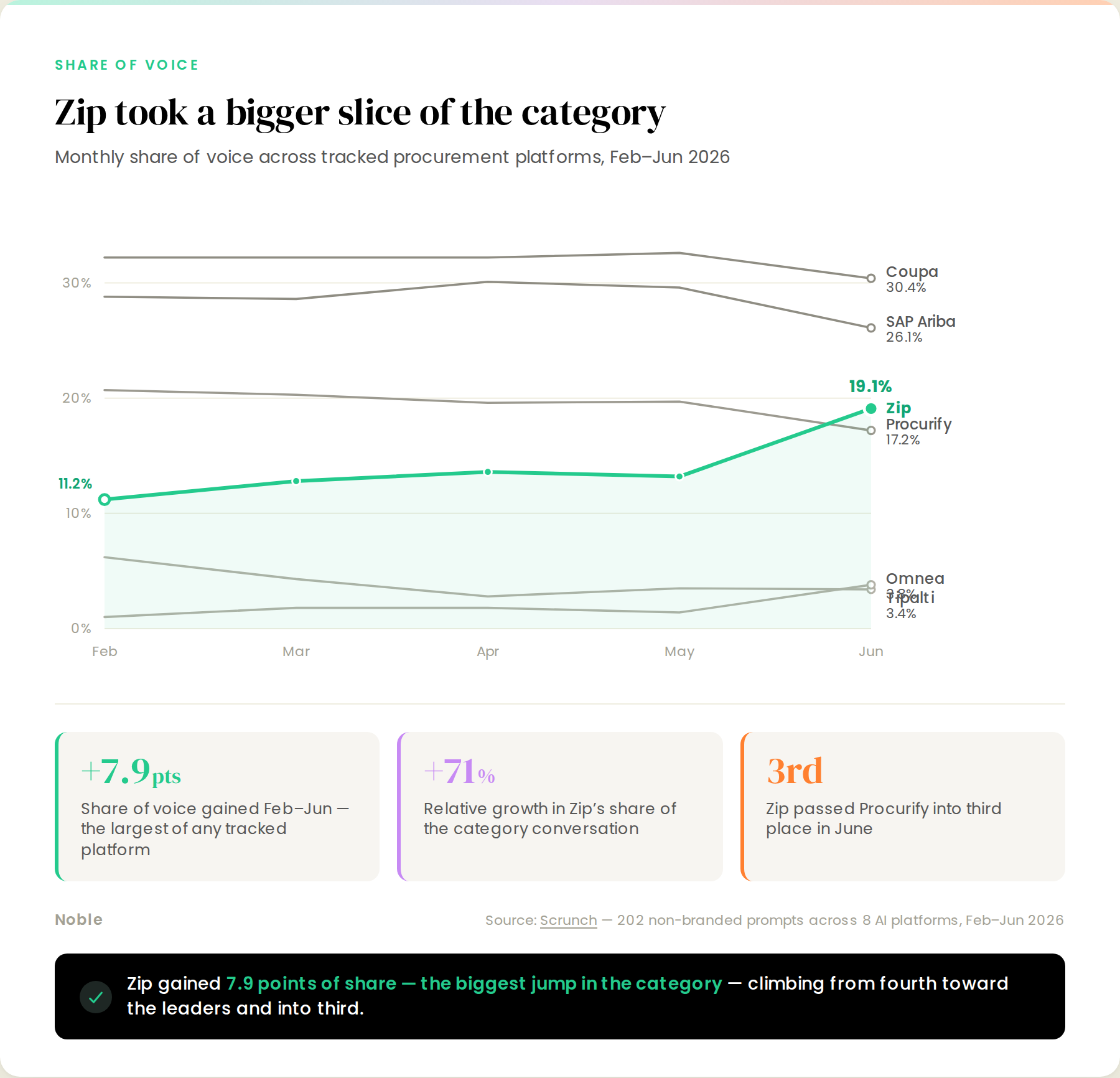
In February, Zip held 11.2% of the share of voice across tracked competitors. Share of voice measures how much of the category's conversation mentions Zip in comparison to tracked competitors. At the start, Zip held fourth place behind competitors like Coupa (32%), SAP Ariba (29%), and Procurify (21%). For a platform valued at $2.2 billion with a strong market standing, that was a footprint in AI answers that didn't match its standing in the market.
The gap was a distribution problem, not a brand one: Zip wasn't present in the third-party sources AI models pull from. That’s where Noble comes in.
AI tools don't answer "what's the best procurement platform?" from a company's own website. They build the answer from trusted outside sources that other people publish.
The research backs this up plainly: one analysis from AirOps found 85% of brand mentions in AI answers come from third-party pages, not a brand's own site. And Ahrefs, after studying 75,000 brands, found that mentions on other websites were the single strongest predictor of whether a brand showed up in AI answers.
So the path was clear: get Zip into those outside sources, and its presence in the answers should follow.
This was a two-part effort, both critical for a well-rounded AI Search strategy.
On one side, Zip was already investing in its own content by optimizing its website and publishing blog posts, listicles, and competitor comparison pages. That onsite work is what builds authority and helps the AI answer specific questions about your brand, such as pricing, product features, etc.
Noble, on the other hand, was responsible for getting Zip mentioned in outside sources. Over roughly four months, Noble placed Zip in 14 third-party articles, which were a mix of comparison pieces, roundups, and category guides, each chosen because it was relevant to procurement questions and had a track record of being cited by AI tools. Those placements are now showing up as cited sources in the AI answers Zip appears in.
The two efforts covered different ground, and the results below reflect both working together.
Presence was tracked with Scrunch, an AI visibility platform, across eight AI tools, using 202 non-branded prompts. Those are questions that name no company, like "best procurement software for enterprises."
Campaign Snapshot
Client: Zip (procurement orchestration platform)
Duration: ~4 months (Feb–Jun 2026)
Noble's work: 14 third-party article placements
Zip's own work: on-site content and page optimization
What we measured: 202 non-branded prompts, 2,929 responses
Tool: Scrunch, across 8 AI platforms
Two numbers tell the story, and they measure different things. Presence is how often Zip shows up in AI answers. Share of voice is how Zip is doing compared to its rivals.
At the start, Zip appeared in about 29% of AI answers to its non-branded questions. By late June, it appeared in 52% — a 78% relative increase. And it climbed steadily and held, rather than spiking and dropping back.
The two long-time competitors still appear more often: Coupa in 80% of answers, SAP Ariba in 71%. But they stayed flat or trended down while Zip climbed toward them, effectively working to close the gap.
Think of share of voice like slices of a pie. There's one pie for all the mentions in the category and every competitor gets a slice. The pie doesn't grow, so for Zip's slice to get bigger, someone else's has to get smaller. It’s important to note that because the share of voice splits that one fixed pie, its starting numbers look different from AI presence. When looking at share of voice, Zip began at 11.2%.
Zip's slice then grew and rose from 11.2% in February to 19.1% in June. This is a 71% relative increase, and the biggest gain of any platform we tracked (+7.9 points of the pie).
Over the same stretch, four of the five competitors we tracked lost ground. And in June, Zip passed Procurify (17.2%) into third place, behind only Coupa (30.4%) and SAP Ariba (26.1%).
"We found our competitors showing up in LLM results more often when buyers were asking bottom-funnel queries, because those answers were trained on third-party sources we had limited visibility or influence over. In four months, Noble helped us nearly double how often we appeared in bottom funnel LLM output, from about a quarter of answers to more than half.”
— Brooks Rocco, Content Lead, Zip
AI visibility isn't locked, even in a massive category with huge competitors. Zip grew its presence in AI answers 78% (relative) in four months and gained more ground than any platform we tracked, climbing while long-established leaders stayed flat. These positions aren't fixed.
Non-branded questions are won on outside sources. According to Scrunch, 95% of the sources behind these AI answers were third-party pages; only 1% were Zip's own site. If you're not in the outside coverage AI pulls from, you're not in those answers.
Consistent placement in third-party sources holds over time. Zip's presence climbed steadily and stayed at its high rather than spiking and fading. With coverage still growing, the gains are still building.
This campaign is still live. Zip continues to invest in its own content and page optimization, and Noble continues to place Zip in the outside sources AI tools cite. As that coverage grows, we expect Zip's presence and share of voice to keep climbing. We'll update these results as the data matures.
To get started with Noble, click here.
What we measured. Presence and share of voice were tracked via Scrunch across 8 AI platforms, February 20 – June 30, 2026, using 202 non-branded prompts and 2,929 responses. Presence is how often Zip appears in AI answers to the tracked questions. Share of voice is Zip's share of all mentions across the six tracked competitors (Zip, Coupa, SAP Ariba, Procurify, Omnea, Tipalti). All percentage changes are relative (not percentage-point) unless stated otherwise. Data as of June 30, 2026.
Who did what. Noble's 14 third-party placements ran alongside Zip's own on-site content program during the same window. Noble's placed URLs now appear as cited sources in the tracked answers. These results reflect both efforts running together and are presented as correlation over time, not proof that any single input caused the change.
Limitations. No control group. Competitor movements may reflect their own activity as much as Zip's. The analysis covers a single measurement window without a pre-campaign historical baseline. Share of voice is measured against the six tracked competitors, not the entire market. Zip's move into third reflects recent, single-month movement and is described as such. For the full methodology and raw data, contact Noble.
GET DISCOVERED ON