All resources

How to Build Your Prompt List to Surface More Mentions

Delia Rowland

June 18, 2026

6

minutes read

How-to

Your prompt list is the set of questions your prospects are actually typing into ChatGPT, Perplexity, and Google's AI answers. It's also the starting point for everything Noble does next: the prompts you give us define which sources we go after on your behalf. 

Every genuinely relevant prompt you add widens the set of sources we can pursue, and that means more chances to get your brand mentioned where buyers are looking.

This guide covers what makes a prompt worth uploading, where to find yours, how to generate more with AI, and how to keep your list sharp over time. 

In this post

  • What makes a good prompt
  • Where to find your prompts
  • How to generate more prompts with AI
  • Found a source you want to be in? Upload it directly
  • How often should you refresh your prompts?

What makes a good prompt

A good prompt sounds like your buyer asking a question, not like your marketing team describing your product.

Here are 5 things to keep in mind while building your prompt list:
  1. Write the buyer's question, not your brand name. Your prospects don't search for you, they search for a solution to a problem. Which is often before they know your company exists. The strongest prompts mirror how your audience actually asks questions in AI tools, not how your internal team describes the product. "Is [YourBrand] any good?" tells us little. "Best project management tool for small agencies" tells us exactly where you need to show up.
  2. Be specific. Generic, high-volume queries tend to produce noisy, irrelevant data, while prompts mapped to specific buyer intent are the ones that move the needle. In our experience, the two things that most change which sources surface are functionality and persona. Pair a specific capability with a specific type of buyer (think "help desks for SMBs") and you'll surface the most distinct, winnable sources.
  3. Write like people talk. AI prompts are full questions, not keyword fragments. People type complete, conversational sentences into ChatGPT, which is why longer queries of four or more words tend to mirror real AI search behavior. A practical target is natural phrasing in the 12-to-25-word range. "Treasury management software" is a keyword. "What's the best treasury management software for a company managing cash across multiple banks?" is a prompt.
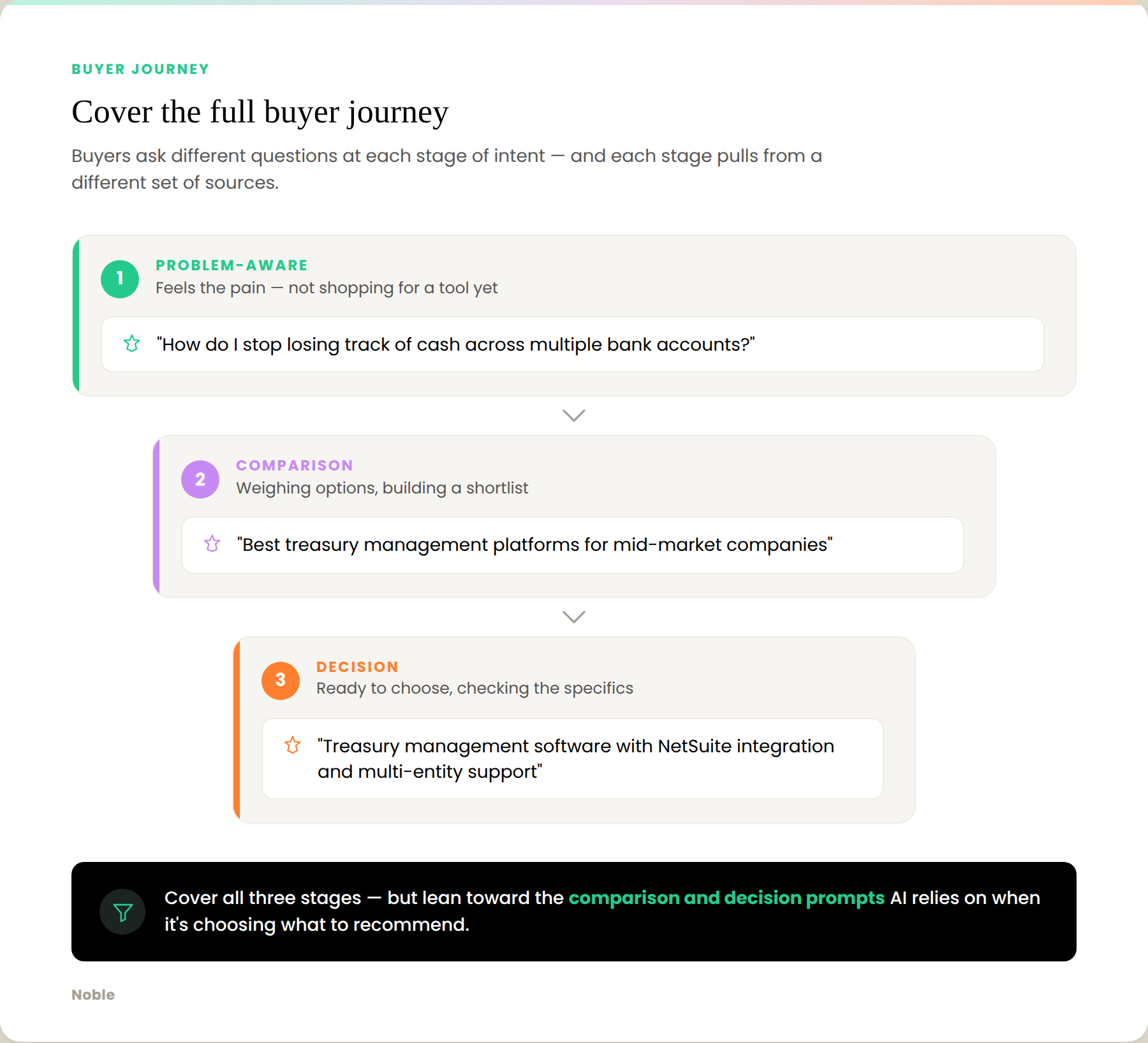
  4. Cover the full buyer journey. Buyers ask different questions at different stages, and each stage pulls from different sources. A list skewed to one stage leaves whole categories of sources uncovered. The most valuable prompts tend to cluster around the moments when AI is weighing options and recommending solutions: the comparisons, evaluations, and "best" queries that sit lower in the funnel. Cover all three stages:
  • Problem-aware: "How do I stop losing track of cash across multiple bank accounts?"
  • Comparison: "Best treasury management platforms for mid-market companies"
  • Decision: "Treasury management software with NetSuite integration and multi-entity support"
  1. Lean toward non-branded questions, but keep the high-intent comparisons. Most of your list should be questions asked by people who don't know you yet, since that's where you stand to win new visibility. Pure navigational prompts like "[YourBrand] login" or "[YourBrand] pricing" are the least useful here because the person searching already knows you. But don't throw out every prompt with a brand name in it. Comparison and alternative prompts like "[YourBrand] vs [Competitor]" or "best [Competitor] alternatives" are some of the highest-intent queries there are, and they pull from exactly the kind of comparison articles you want your brand placed in.

Where to find your prompts

Knowing what good looks like is half the job. The next is finding enough of them, and you don't have to invent them from scratch. Where you start depends on whether you're already running an AI visibility tool.

If you already use a visibility tool

If you're on Profound, Otterly, Scrunch, Ahrefs Brand Radar, or something similar, you've got a head start. Three places to pull from are:

If you're starting from scratch

If you don’t have a tool yet, that’s okay! Here are the resources you have at your disposal to get started: 

  • Sales calls and support tickets. The exact language your buyers use, in their own words. These rank among the highest-signal prompt sources, and competitors can't replicate them. Skim recent transcripts and tickets for the questions that come up again and again.
  • Google Search Console. Filter for the questions your site already ranks for, especially longer queries. They already reflect how real people phrase things.
  • People Also Ask. Google's related-question boxes are a ready-made list of how people ask about your category.
  • Reddit, Quora, and forums. Where real potential customers are already asking questions. Google often surfaces these forum discussions right in the results, so they're easy to mine.

How to generate more prompts with AI

Once you've got a starting list, AI can help you expand it fast. Asking an LLM to generate prompts across intent stages is a proven research method. The trick is giving the model enough context to think like your buyer, and asking it to vary the angle so you don't get five versions of the same question.

Copy this prompt, fill in the blanks, and run it in ChatGPT, Claude, or any LLM. It generates five buyer-style prompts at a time, each from a different angle.

CONTEXT

You are a content generation AI. You will create five LLM-ready search prompts

that a potential prospect of [YOUR COMPANY] might use when seeking a solution

in the [YOUR CATEGORY] category. The prospect does not know the company's name;

they only know their problems or the general product category.

OBJECTIVE

Generate five concise, natural-language prompts a prospect would type into an

LLM to find solutions in the [YOUR CATEGORY] category that align with the

problems solved by [YOUR COMPANY].

INSTRUCTIONS

- Do not mention the company name [YOUR COMPANY] in the prompts. Focus on pain

  points, desired outcomes, and the product category [YOUR CATEGORY].

- Make each prompt:

  - Specific to likely pains, benefits, and selection criteria in the category.

  - Actionable and query-like (what a user would actually ask an LLM),

    12-25 words each.

  - Varied by angle: one pain-focused, one outcome-focused, one

    comparison/evaluation, one integration/compatibility, one ROI/efficiency.

- Output format must be a list of five prompts, each wrapped in double quotes,

  comma-separated, inside square brackets.

- Do not add commentary, labels, or bullets.

EXAMPLE

Input:

- Company Name: AcmeAI

- Product Category: sales enablement

Output:

["Best LLM prompts for evaluating sales enablement tools that shorten rep ramp

time and improve win rates", "How to choose a sales enablement platform that

personalizes content by buyer persona and integrates with CRM", "Compare top

sales enablement solutions for onboarding speed, content analytics, and coaching

insights", "Sales enablement options that auto-generate battlecards from call

transcripts and reduce time to first meeting", "ROI-focused sales enablement

platforms that prove content influence on pipeline and forecast accuracy"]

A few tips for using it well:

  • Run it once per product, category, or use case. A company with three product lines should run it at least three times.
  • Keep the five angles. Pain, outcome, comparison, integration, and ROI spread your prompts across the buyer journey instead of clustering in one spot.
  • Check the output against real buyer language. AI gives you a strong first draft, not a final list. Because a model guessing at prompts can invent queries no one actually searches, sanity-check what it returns against the sources from the last section, then cut anything generic or off.

Found a source you want to be in? Upload it directly

Work through your prompts and you'll almost always stumble onto something specific: a roundup, a comparison article, a forum thread you already know LLMs lean on for your category. When that happens, you don't have to wait for us to rediscover it.

Noble lets you upload citations, not just prompts. If you already know the exact sources shaping AI answers in your category, add them directly and we'll go straight after a placement. 

Here’s a tutorial video on how to upload citations: https://www.youtube.com/watch?v=eL-kTEcBSTM 

How often should you refresh your prompts?

Your prompt list isn't set-and-forget. The way buyers ask questions shifts, your category evolves, and you launch new things worth showing up for.

A good rhythm is to revisit your list every 30 to 60 days, plus any time something material changes:

  • You launch a new product or feature
  • You move into a new category or reach a new audience
  • Your positioning or messaging shifts
  • A new competitor starts showing up in answers you care about

There's also a reason to keep adding prompts over time, even past what a tracking tool might recommend. When the goal is measuring visibility, the standard advice is to keep your list tight, because too many prompts adds noise to the data. Finding placements works the other way around. Every genuinely relevant prompt widens the set of sources we can pursue for you, which means more chances to show up where your buyers are looking.

So when you're on the fence about a prompt, add it. As long as it reflects a real question a real buyer would ask, it earns its place.

Whenever you’re reviewing prompts to add to your list, it’s worth spending a minute on some quick cleanup:

  • Cut the duplicates. "What is treasury management?" and "How does treasury management work?" lead to the same answer, so keep the clearer version and drop the rest.
  • Drop anything off-target. If a prompt doesn't reflect what you actually sell, it points us at the wrong sources.
  • Prioritize by intent, not volume. AI prompts don't come with clean search-volume data, so the better question isn't how many people ask it, but whether the answer puts you in front of the right buyer.

Ready to upload your prompts? Watch our quick tutorial on how to do it here: https://www.youtube.com/watch?v=c5M0YenE2QI 

Let’s win AI search

GET DISCOVERED ON