All resources

Delia Rowland
Case study
The ABM Agency is a global account-based marketing agency trusted by some of the world's largest enterprises, with a track record of turning B2B organizations' biggest accounts into measurable revenue since 2009. Ask an AI which account-based marketing agency to hire, and they show up.
But by 2026, buyers were asking AI a new question: not just who runs their account-based programs, but who can get them found and cited by AI in the first place. So The ABM Agency moved into generative engine optimization and answer engine optimization, an adjacent category where, on the questions that mattered, they didn't appear at all.
To get there, they'd reached for the classic SEO playbook: publishing their own "best of" roundups and ranking themselves at the top. For a while that worked across the industry, as search engines and early AI crawled those pages and took the rankings at face value. But after a while, it backfired. As search engines and AI tools got better at spotting the bias in a company that ranks itself first in its own review, firms that relied on the tactic saw sharp visibility losses, in some documented cases dropping 30 to 50 percent within weeks. Worse, a company could end up cited as a source in an AI answer while the competitors listed alongside it were the ones recommended.
The reason is simple: an AI doesn't take a company's word for its own quality. It builds each answer from the independent sources that discuss a topic, and in the sources shaping GEO and AEO answers, no one was mentioning them.
So the work split in two. The ABM Agency kept creating high-value content on its own site, the part it could control. Noble took the part it couldn't: getting named in the third-party sources that shape the answers.
According to Muck Rack's What Is AI Reading report, over 95% of the links AI cites come from non-paid, earned media rather than a brand's own paid or owned channels. It makes sense: when someone asks an AI something like "which agencies help B2B brands get cited by AI," the assistant has no objective answer of its own, so it leans on what independent sources say.
A brand that appears across those sources is far more likely to appear in the answer.
Noble's job was straightforward: place The ABM Agency in the third-party articles LLMs already cite for the questions their customers are asking. Then, presence in the AI answers would follow.
Over roughly four months, Noble placed The ABM Agency in 12 third-party articles including independent roundups, comparison guides, and industry pieces covering AI search, GEO, AEO, and the wider B2B marketing agency landscape. We started by tracking the prompts their customers were asking AI for that category, finding the sources the AI already trusted in its answers, reaching out to the publishers, drafting the copy, and making sure everything went live.
AI visibility was tracked in Scrunch, which records how AI assistants respond to a defined set of buying questions and how often a given brand is named. The questions here were the open, high-value ones, known as "non-branded prompts." These are questions like "Which agencies help B2B brands show up in AI answers?" or "Best AEO agencies for B2B SaaS" the buyer names no company, so the AI builds its shortlist from whatever independent roundups and comparison guides it trusts on the topic.
The engagement at a glance
Length: about four months
Placements: 12 third-party articles
Focus: open, non-branded questions about which agency gets B2B brands found and cited by AI (GEO/AEO)
Measurement: Scrunch, across 85 questions and ~500 AI answers
As you can see in the chart below, when the measurement window opens in mid-April, The ABM Agency is absent. On these buying questions, they appear in effectively none of the AI answers; and this is with ten of the twelve placements already live.
That changes at the start of May. Within a single week, their presence rises from zero to about 12 percent, roughly one in eight answers, and holds there.
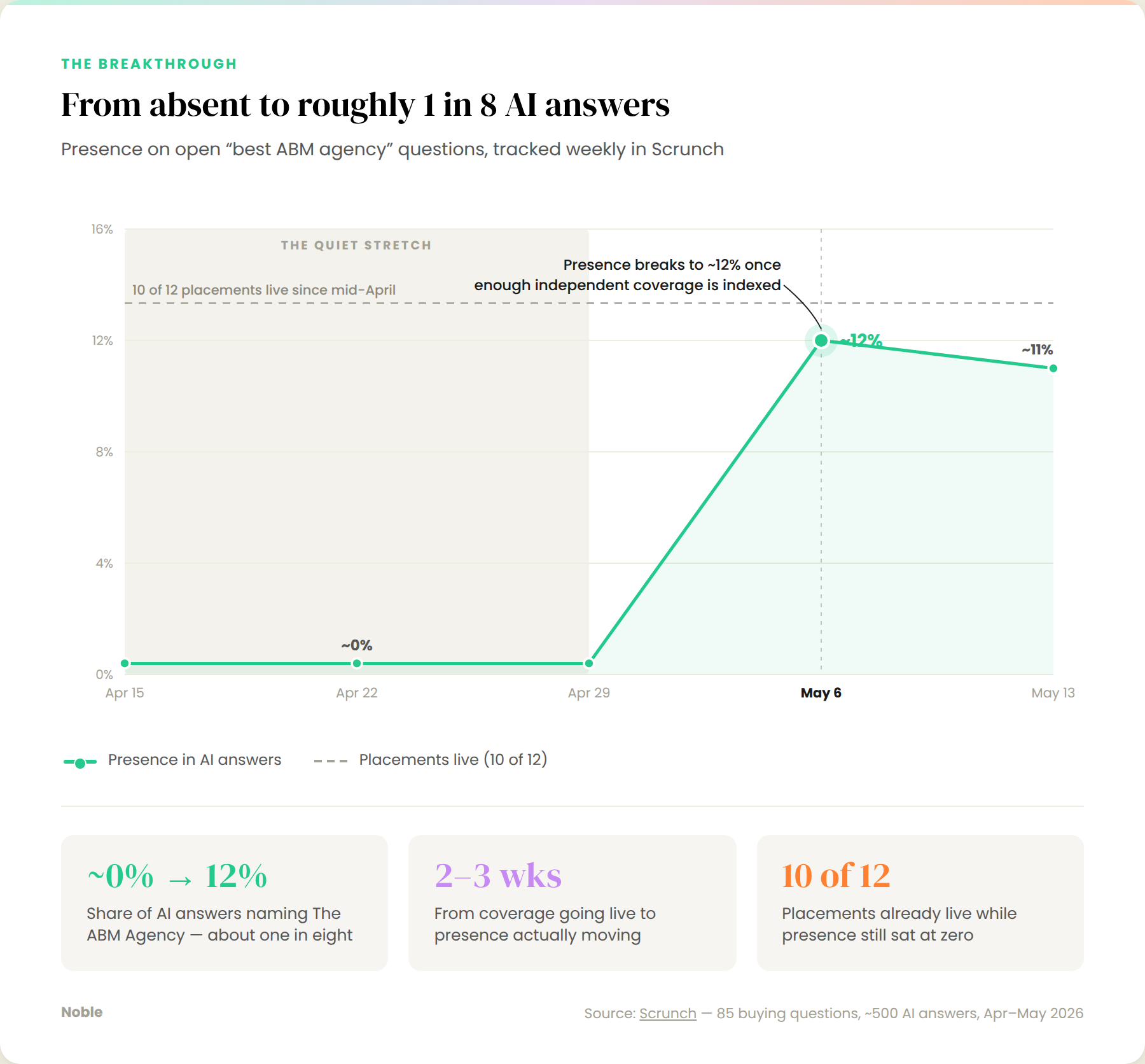
The gap between the articles going live and the visibility moving isn't unusual. An AI has to find each article, read it, and decide it's worth drawing from, which here took somewhere in the range of two to three weeks.
The AI also needs enough data points to corroborate the information across sources. One placement isn't enough to sway an answer in your favor; it needs a bulk of evidence before it will surface a name.
That's why ten articles sat live through late April while presence stayed at zero. Once enough of them had been picked up, visibility jumped significantly. This aligns with what we've seen elsewhere about the time and volume of mentions it takes to move an answer.
February to April: Placements go live in batches. By mid-April, ten of the twelve are published. Presence on the buying questions: still near zero.
Late April: Coverage continues to be indexed, and the line stays flat.
Early May: Presence breaks to about 12 percent, and The ABM Agency goes from absent to roughly one in eight answers, holding there through mid-month.
"We can shape everything on our own site, but couldn't scale the process of getting the agency into the third-party articles buyers actually trust. More and more, that's where AI gets its recommendations. Noble handled those off-site placements for us, and we went from missing on those questions to showing up in 1 in 8 AI answers."
— Vincent DeCastro, President of The ABM Agency
An AI won't recommend you on your own say-so. It builds its answers from sources it treats as independent, so the only dependable way into the recommendation is to be named by someone other than yourself.
The result came as a breakthrough, not a trickle. Presence held at zero for weeks while coverage was published and absorbed, then stepped up to roughly one in eight answers all at once. The placements created the foundation, and the jump came when enough of them had landed.
Starting from zero isn't a limiting factor. Going from complete invisibility in a new category to one in eight answers shows the starting point doesn't decide the outcome. The breakthrough didn't come from luck or from one lucky article; it came from strategy: the right sources, the right questions, and enough coverage to tip the answer.
94% of B2B buyers now use AI in their purchase process, and for many it's become the most important place they research vendors, which means questions like these get asked all day, every day. Showing up in one in eight of those answers puts The ABM Agency in front of a steady stream of buyers at the exact moment they're deciding who to trust.
This reaches well beyond any single category. More of your buyers are making their shortlist inside an AI answer than on your website, and that answer is built from sources you can't edit.
We’ll continue to update these results as more mentions are placed.
To get started with Noble, click here.
We used Scrunch to track how often The ABM Agency was named in AI answers across 85 buying questions and roughly 500 responses. The questions were limited to open ones where no company is named.
The presence chart covers the four weeks ending mid-May 2026, the window this Scrunch view makes available. Placements ran from February through May, so the chart captures the breakthrough but not the full build that preceded it. Only placements live within that window are counted; mentions that went live afterward, including two in late June, fall outside it and aren't included.
"Appeared in about 12 percent" means The ABM Agency was named in roughly that share of AI answers to the tracked questions. The two-to-three-week gap between a placement going live and presence moving is consistent with how long AI tools take to find and trust new sources, and is best read as an observed pattern here rather than a fixed rule.
The usual limits apply. There's no control group, and the four-week window doesn't show the earlier build. Other factors, such as competitor activity or model updates, may have contributed. This is a clear and consistent move, not a controlled experiment.
For the full methodology and raw data, contact Noble.
GET DISCOVERED ON