.png)
New research analyzing 28,000+ LLM outputs and citations reveals exactly where AI gets its information about brands, which content types earn the most citations, and what happens when you act on it.
TL;DR: Omniscient Digital analyzed 5,300+ LLM outputs and 23,000+ AI citations across branded queries and found that 77% of what LLMs cite comes from offsite sources… not your website.Your own content accounts for just 23% of citations. Brands show up in AI answers even when users aren't shopping (28% of problem-aware queries include brand recommendations). Reviews, listicles, forums, and social proof alone account for 57% of all citations, making them the single largest content type bucket.
In this post
When someone asks ChatGPT or Perplexity about your brand, where does the answer come from?
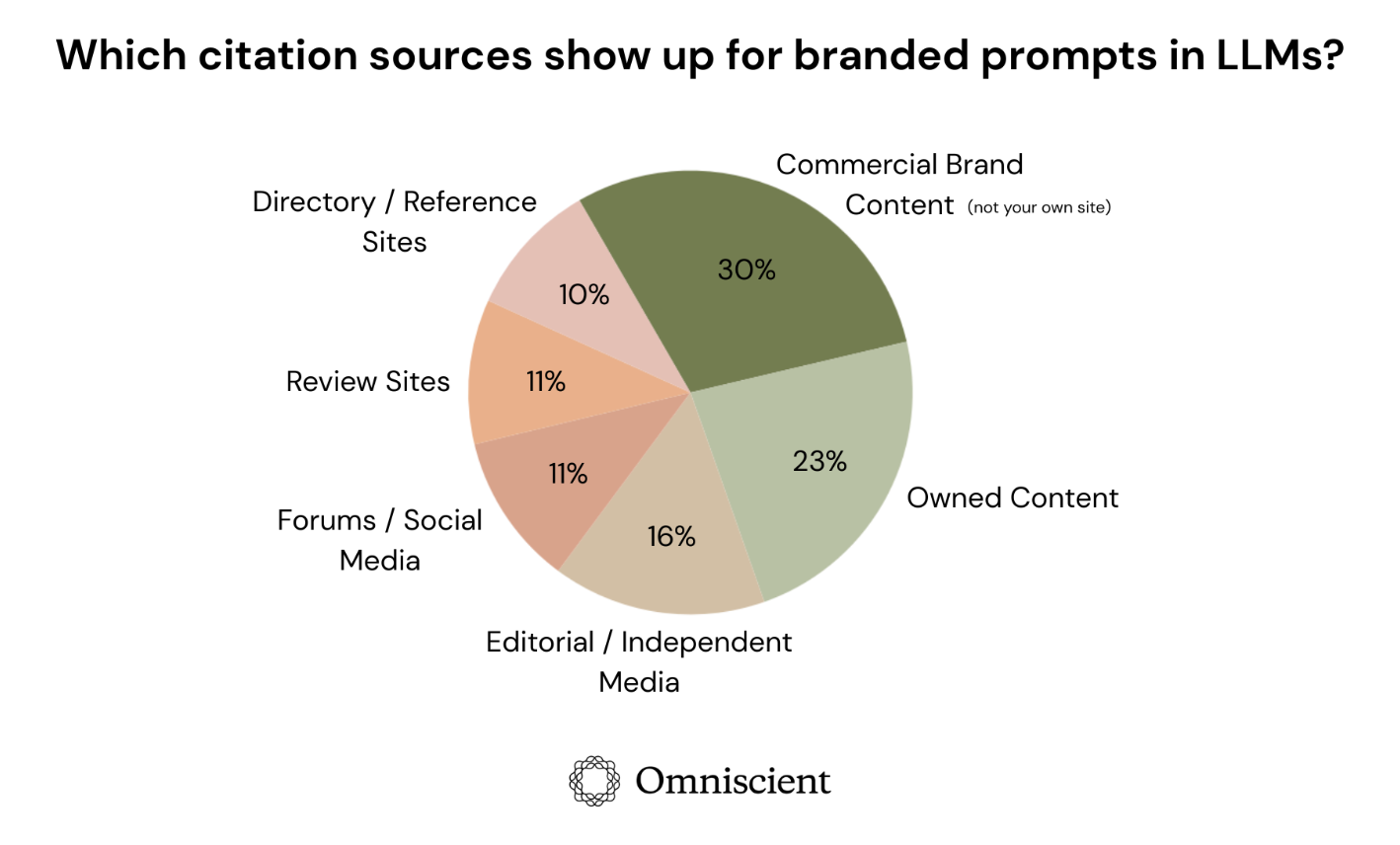
Most marketing teams assume it's their website. Omniscient Digital's research across 23,000+ AI citations says otherwise: your own site accounts for roughly 23% of what LLMs reference in branded queries. The other 77% comes from review sites, listicles, competitor pages, directories, and forums.
We sat down with Alex Birkett, co-founder of Omniscient Digital, to dig into two original research studies his team published — one covering 5,300+ LLM outputs across funnel stages, the other analyzing 23,000+ citations by content type. What follows are the key findings and what they mean for how you invest in AI visibility.
Most AI search strategies focus on "best X" queries, which is the moment someone is actively comparing solutions. That makes sense. But Omniscient's research shows brands are entering AI answers much earlier in the buyer journey.
Their team ran 180 prompts across 5 LLMs, split evenly across three stages: problem unaware, problem aware, and solution aware. The results:
That middle number is the one worth sitting with. Nearly a third of the time, when someone describes a problem to an LLM without asking for a product, the model introduces brands anyway.
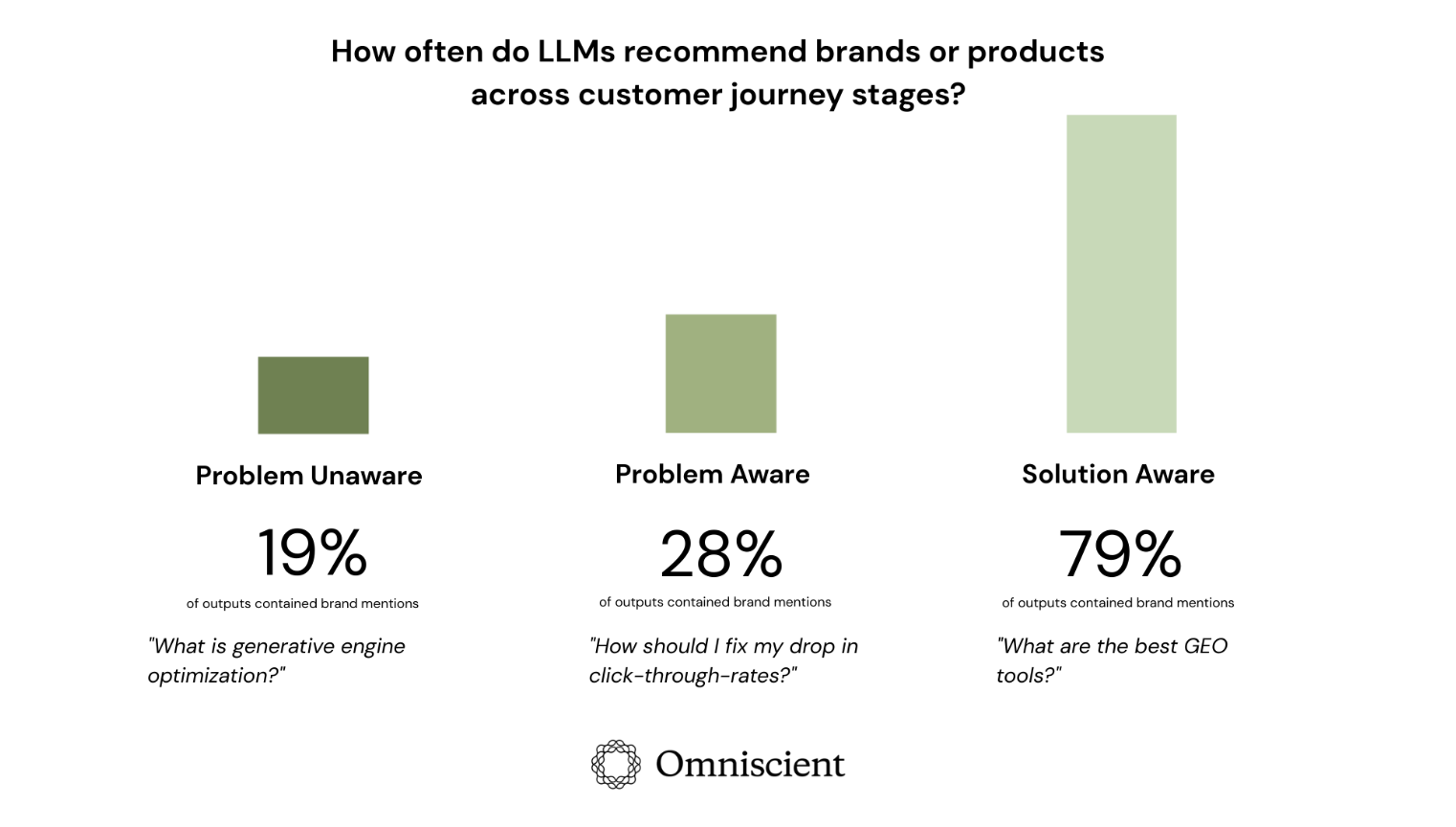
Alex gave a practical example in conversation: a user asks about a smoking oven, gets step-by-step troubleshooting advice, and step three recommends a specific oven cleaner by name. No purchase intent in the query. The brand showed up because the model associated it with the solution to the problem.
The variation by category is significant too. B2B SaaS prompts triggered brand mentions 57% of the time across all stages. SEO-specific prompts hit 77%. Legal services sat at just 19%. LLMs are more willing to name brands in categories where products are standardized and comparisons are expected.
So, if you're only tracking your visibility in "best X" listicle queries, you're missing up to a third of the moments where AI is already forming brand associations in your category. That gap between where buyers search and where brands show up compounds over time.
This is the finding that should reshape how you allocate your AI search effort.
When someone asks an LLM about a specific brand by name, Omniscient's analysis of 23,000+ citations found the following source breakdown:
Less than a quarter of what AI tells people about your brand comes from you.
And the split gets more extreme depending on what the buyer is asking. For customer review queries ("What do people think of X?"), earned media accounts for 82% of citations. LLMs pull from TrustPilot, Reddit, and social platforms — not the brand's own site. Even for functionality and integration questions — the most "owned" category — the brand's content only shows up about half the time.
Alex shared a finding from the conversation that surprised even his team: for branded bottom-of-funnel queries (pricing, product comparisons, "is X worth it" type searches), roughly 75% of citations still came from off-page sources. Competitor versus pages, independent review sites, and third-party publications dominated.
"I hope that changes," Alex said. "I think it probably should pull from your website if somebody's asking about you."
But right now, it doesn't. And that means even your most brand-specific, highest-intent queries are being answered primarily by what other people have written about you.
There's another layer to this. When people think about offsite citation sources, they think Reddit, Wikipedia, maybe LinkedIn. But as Rahul Jain (Noble's CEO) pointed out in conversation, those big-name sources combined represent less than 10% of total citations for most categories.
The real volume sits in hundreds of smaller publishers, blogs, and listicle sites that nobody tracks by default. Category-specific roundups. Niche comparison articles. Industry vertical publications. That long tail is where most of the citation surface area lives, and it's where the biggest gaps tend to be.
So offsite sources dominate. But which specific content types are LLMs pulling from?
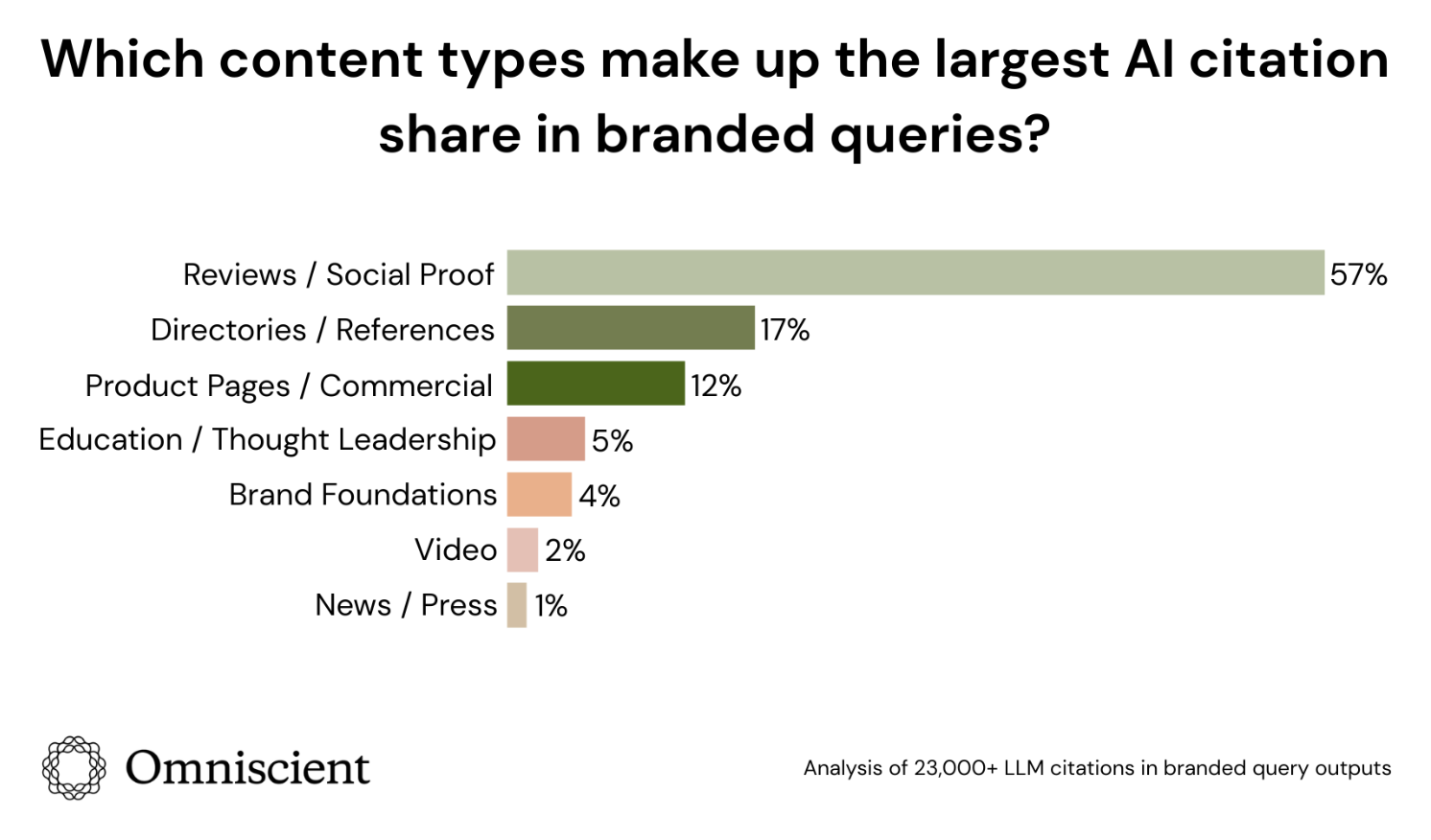
Omniscient's team categorized all 23,000+ citations into seven content types. The hierarchy:
Reviews and social proof account for more than half of all citations in branded queries. Listicles alone are a major driver within that bucket — LLMs cite them frequently because they summarize a category, compare features, and mirror how people actually evaluate options.
Two findings here that challenge popular tactics.
FAQ pages are a common AEO recommendation. The logic is intuitive: if users are asking questions and your page answers them in that exact format, the LLM should cite it. But in Omniscient's data, FAQ pages accounted for just 0.41% of branded query citations. They're not moving the needle.
Thought leadership (blogs, research, how-to guides) came in at 5.4%. That's much lower than most content teams would expect given how much they invest in it. Thought leadership builds authority and shapes how models understand your brand over time, but it's not what gets cited when buyers ask about you directly.
The encouraging part of Omniscient's analysis: you can directly control or influence 8 of the top 10 cited content formats. Listicles, product pages, pricing pages, blogs, case studies, documentation, video, and brand profiles are all within your reach — either through your own publishing or through outreach.
The two you can't fully control are reviews and forums. Those are earned through product quality and customer experience.
As Alex put it in conversation: "Take your data and figure out what you can effectuate and then what the impact of that would be." The research tells you where citations come from. Your job is to figure out which of those sources you can get into — and which gaps are costing you visibility.
The research points to a clear set of priorities:
1. Prioritize the content types that actually get cited. Listicles, roundups, comparison articles, and review sites account for the majority of branded citations. FAQ pages and thought leadership don't. That doesn't mean you stop publishing thought leadership, but if your goal is citation presence, the leverage is in getting your brand placed in the content types LLMs prefer to reference.
2. Think full-funnel. The funnel stage data shows brands surface in 28% of problem-aware queries. If you're only targeting solution-aware listicles, you're missing the moments where AI is forming brand associations earlier than you expected.
3. Don't let your analytics undercount the channel. Click-based attribution significantly understates AI search influence. Omniscient's own data shows a 5-10x gap between click-attributed LLM leads and self-reported ones. If you're using click data alone to decide how much to invest here, you're working with a fraction of the real picture.
To hear the full conversation with Alex Birkett, watch it here.
About Omniscient Digital Omniscient Digital is an organic growth agency that helps B2B software companies turn SEO, GEO, and content into growth channels. Their original research on AI citation patterns, buyer behavior, and content strategy is available on their blog.
About Noble Noble is an AI search platform that automates the outreach, negotiation, and payment required to get your brand mentioned in the sources LLMs cite. The result: you show up in AI-generated answers. Get started here.
GET DISCOVERED ON