All resources

Delia Rowland
Case study
.png)
Before working with Noble, the marketing team at Folloze was tracking their AI visibility by hand. Folloze is a platform marketers use to target and convert their key accounts through personalized microsites and ABM campaigns.
Pulling prompts, logging which answers named them, building a picture from scratch of where they appeared and where they didn't is a process that's painstaking for any team, let alone a small marketing team like Folloze's.
The problem is that today, you can't just optimize for your own site. When 85% of AI Search citations come from third-party sources, changing what the rest of the Internet is saying about you has to be a priority. Even more so when already more than half of B2B software buyers begin their research inside an AI chatbot rather than a search engine.
What Folloze's manual tracking showed was a split.
On branded queries, where the buyer already knows the name, Folloze appeared. They'd been running an SEO program since 2024 and tuning it for generative engines before most of the category had a name for the practice, so onsite content was strong. But on unbranded queries like "Which ABM platform is best for teams without developers?" and "How do you personalize B2B campaigns at scale?" the answers went to larger, better-known platforms like 6sense and Demandbase. As Folloze's own diagnostics put it: onsite content strong, offsite citations thin. And unbranded is where discovery happens.
Nobody asks an LLM about a product they've already chosen.
The engagement ran as one system with three inputs. Folloze's in-house team owned the onsite work and used Promptwatch to find the prompts where they were invisible. Those gaps went to Noble, which placed third-party mentions on exactly those prompts.
Starting in February 2026, Noble placed Folloze in 12 third-party articles across the clusters their team had flagged as high-intent: personalization platforms, digital sales rooms, account-specific pages, one-to-one ABM personalization, and ABM microsite builders. All twelve were reverse mentions rather than paid offers. Meanwhile the team rebuilt the prompt set each month by pulling from Google Search Console, 6sense engagement data, and competitor reporting, cutting prompts that weren't converting and adding more competitive, comparison-style queries as their focus shifted.
Noble's placements were tracked in Scrunch across 810 non-branded prompts and eight LLM platforms.
When Folloze started with Noble in February, they showed up in about 20% of AI answers to non-branded questions, per Scrunch.
For the first two months, as outreach went out and the earliest mentions went live, presence didn't jump. In April it bottomed out around 14%. The likeliest explanation is lag: placements were going live, and the LLMs hadn't caught up to them yet.
Folloze's own Promptwatch tracking showed the same pattern on a separate prompt set: category visibility near zero in April, then climbing through spring as placements landed, which is consistent with the delay expected between a mention going live and the models beginning to cite it.
Then, through May and June, as those placements accumulated and got picked up and referenced, presence climbed reaching a high of 41.3% in June. That's a relative increase of more than 100% over where Folloze started.
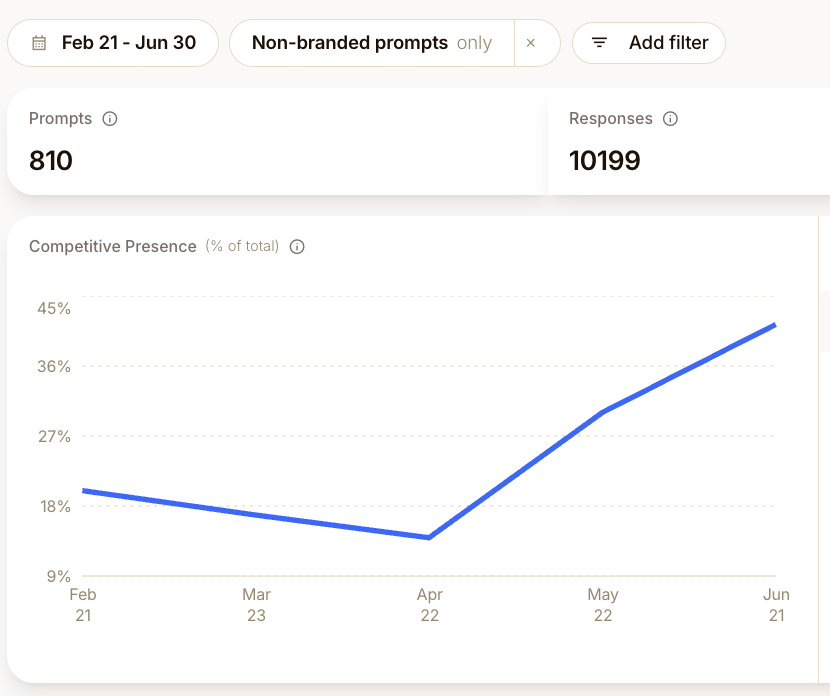
That curve is the honest shape of offsite work. The numbers move week to week; it's the trend over months that matters. It took consistent placement before the LLMs began leaning on those sources, and the early dip before spiking is proof that the payoff was just lagging behind.
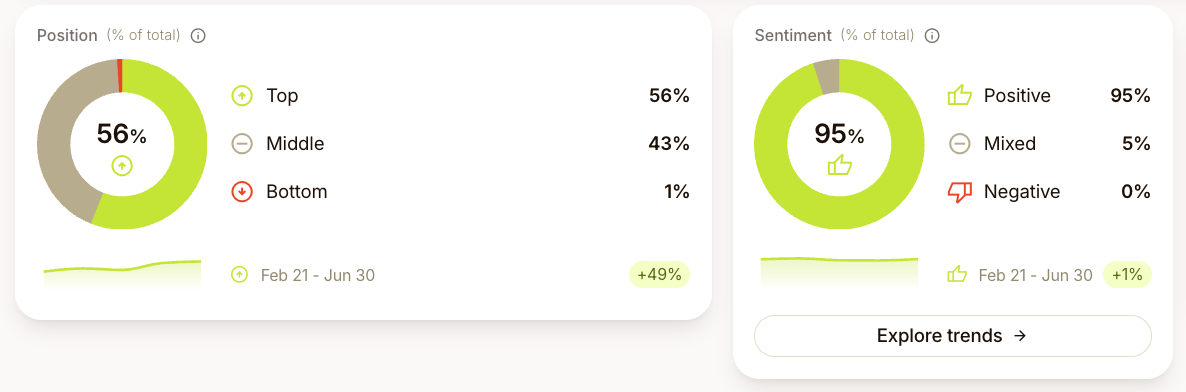
Not only were the models naming Folloze more, they tended to lead with it sooner in the AI answer. Fifty-six percent of Folloze's mentions landed in the top position of the answer, against roughly one percent at the bottom. Moreover, when showing up, the LLMs gave positive responses about Folloze 95% of the time and had zero negative mentions across the measurement period (Scrunch).
"We came in with a strong SEO program but no funded offsite strategy. Noble was the missing layer: the first mention program in our company's history, run with near-zero marginal effort from a lean team. Four months in, we lead every head-to-head comparison, and the category gap is down to single digits."
— Kristi Tutt, ABM & DMM, Folloze
Scrunch is what Noble uses to track presence in third-party answers, but Folloze was tracking the whole system. Here are further results from the same measurement period.
Traffic, not just visibility. A new AI-referral channel in Folloze's GA4 (one that didn't exist a year earlier) recorded 149 AI-sourced sessions in Q2 2026, led by ChatGPT, with ChatGPT referrals up 133% over the prior period.
Head-to-head, they moved to the front. On their own Promptwatch tracking, Folloze led every direct comparison prompt in their category by mid-year, which was ~2.5x the nearest competitor. On the broader category questions, the ones the whole program was pointed at, Promptwatch showed them climbing from effectively zero in April to a top-two position among twenty tracked competitors by July, single digits behind the leader.
These come from Folloze's own tools, GA4 and Promptwatch, which track different prompts than Scrunch and aren't directly comparable to the presence figures above. Taken together, though, three independent measurement systems moved the same direction over the same months as a result of a robust AI Search strategy.
Folloze's presence in AI answers more than doubled. From about 20% of non-branded answers at the start to a high of 41.3% in June (Scrunch), on the questions buyers ask before they've decided what to buy.
Offsite visibility is a long-term play. Presence dipped before it climbed, and the rise came over months as placements accumulated and the models began referencing them. The payoff builds on consistency, not a single push.
A tight budget isn't the blocker. Every Folloze placement was a reverse mention, and they still moved into the answer because the articles were right for the questions buyers were asking. The strongest programs use a mix; the lesson is that being cited in strategic, quality sources drives the result more than what any single placement costs.
Twelve placements built presence in one category. Now, Folloze is building on its ABM foundation to speak to demand generation buyers too, which is a newer audience the models don't associate them with yet.
We’ll update these results as we continue to place mentions.
Measurement period: February 21 – June 30, 2026. Noble's placement results tracked via Scrunch across eight LLM platforms, 810 non-branded prompts, 10,199 responses. Presence measures the share of AI responses that explicitly name the brand; mentions appearing only inside citations are not counted. All figures are a snapshot as of June 30, 2026. Presence reached a high of 41.3% in June; figures fluctuate week to week, and this reflects the engagement's high point rather than a fixed level. Percentage changes, where cited, are relative rather than percentage-point.
Figures attributed to Scrunch and to Promptwatch come from different platforms tracking different prompt sets and are not directly comparable; each is cited separately. AI referral figures are from Folloze's GA4 (Q2 2026).
Noble's placements ran alongside Folloze's own content, optimization, and Promptwatch-guided prompt work. The figures reflect correlation across concurrent efforts and should not be read as single-variable attribution.
For the full methodology, contact Noble.
About Noble: Noble helps you show up accurately and often in AI Search. Most of what AI says about a brand comes from third-party sources, and Noble works with publishers to update inaccurate mentions and add new ones in the sources AI cites, so customers discover you in the answers they read.
GET DISCOVERED ON