All resources

Delia Rowland
Blog
.png)
The most-quoted conversion figures in AI search come from one website.
Seer Interactive published them in June 2025: ChatGPT traffic converting at 15.9% against Google organic's 1.76%.
They were careful about it. The case study's title says "1 site” and the sample was roughly 11,000 AI sessions against 14 million organic ones, from a single client, between October 2024 and April 2025. Their closing line notes this is just one client's data.
Strip those caveats away and you get "AI traffic converts nine times better than organic," which is roughly where the industry landed.
Meanwhile a peer-reviewed study of 973 ecommerce sites found ChatGPT referrals converting worse than every traditional channel except paid social.
Underneath both is the question everybody is asking: does AI visibility actually lead to better business outcomes? And if so, how? Six studies published in the past year have each taken a piece of it: what makes an AI mention worth having, what people do in the week after they see one, how they eventually reach your site, and why your analytics shows almost none of it.
Rather than cherry-picking, we’re looking at how recent data from multiple studies create a broader, clearer picture of how much AI visibility impacts your business - and how to optimize your AI Search strategy to impact it more.
In this post
Being named in an AI answer and being recommended in one are different things, and the gap between them is wide.
Scrunch runs an opt-in panel that joins people's ChatGPT, Claude and Gemini conversations to the same people's browsing. They published a blog summary in June 2026 and a fuller methods paper, which is the version worth reading. It sorts every brand appearance by stance: a genuine recommendation ("a great option is Polar") against an incidental name-drop ("your Netflix download"). Then it tracks what those people did over the next seven days, measured against the same person's behaviour in matched windows two, three and four weeks earlier.
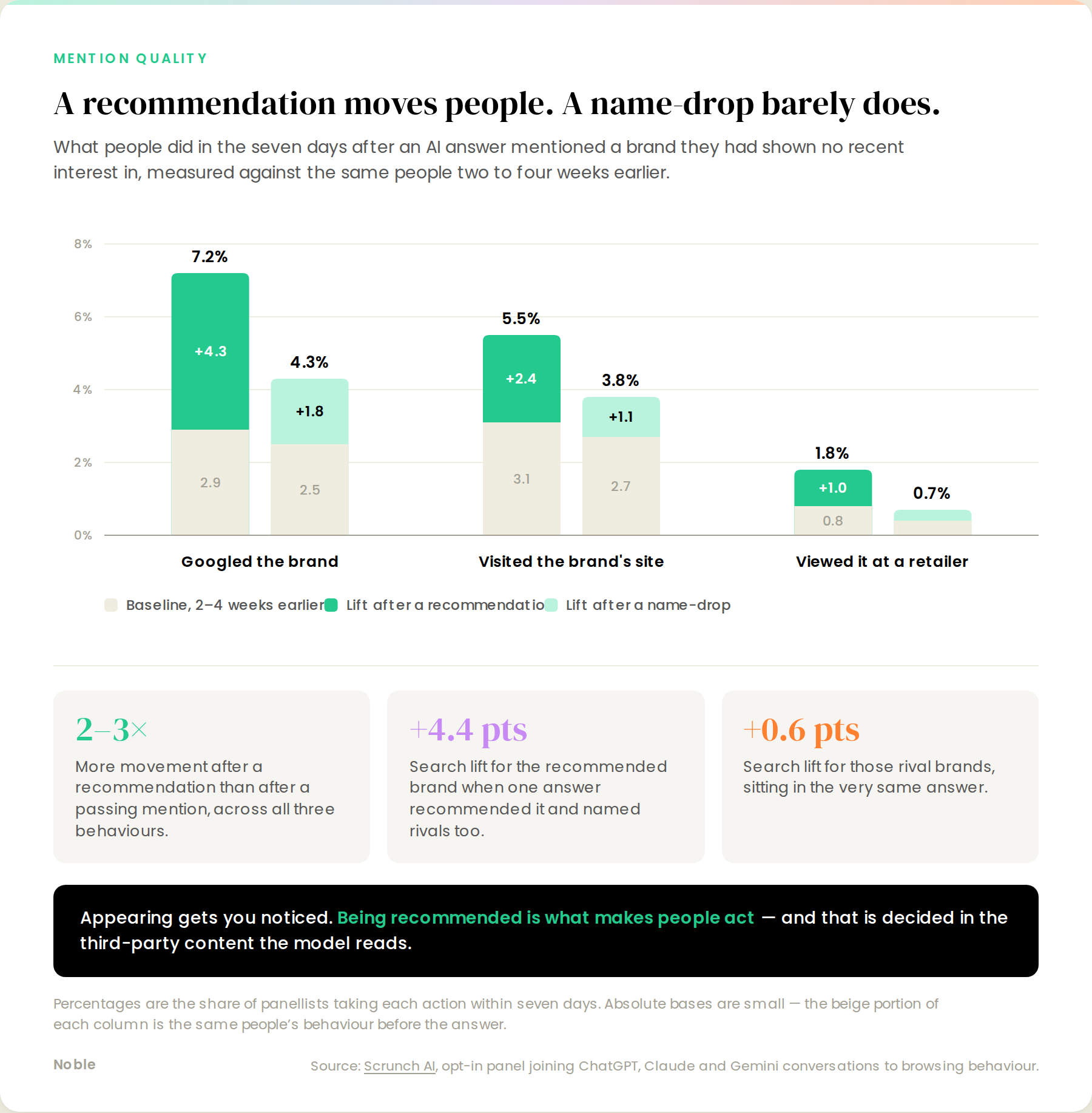
Among users with no recent engagement with the brand:
A recommendation moves people 2-3x more than a passing mention. Being named at all does something. Being put forward does considerably more.
The most interesting finding sits inside a single answer. When a response recommended one brand and also named its category rivals, the recommended brand drew +4.4 points of search lift while the unnamed rivals in that same answer drew +0.6. Same user, same session, same conversation. Only the recommended brand moved.
So, to maximize conversions, focus on not just being in the answer but being recommended in the answer. You can check whether AI speaks positively about your brand by referring to the “sentiment” percentage within an AI visibility tool. In the case you don’t use one of these tools, it’s important that the third-party content that mentions you is accurate and in line with the positioning of your business. That determines whether you get recommended at all.
People go looking for the brand that got recommended. Three research teams have measured this separately, on different panels with different designs, and their answers line up.
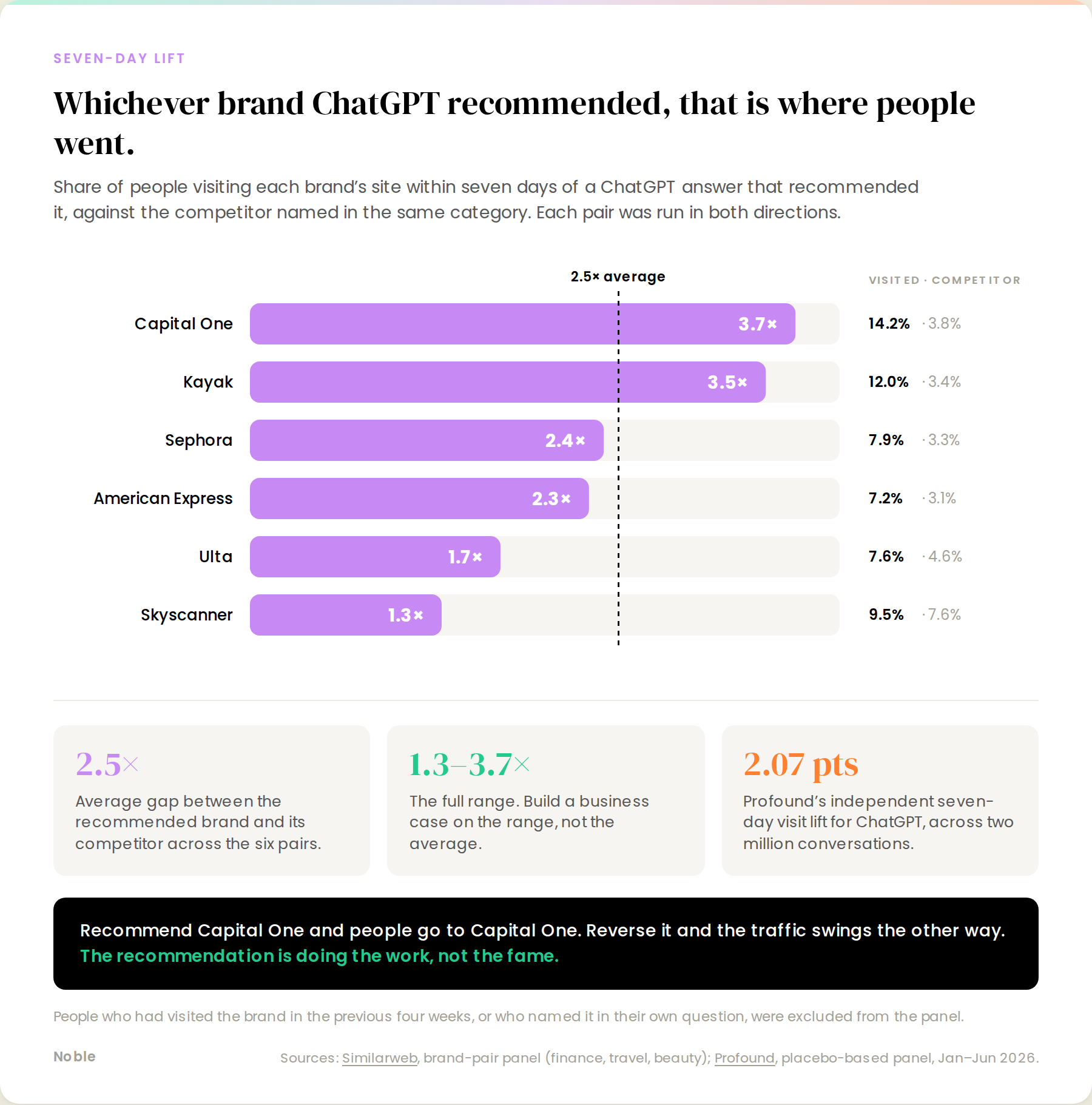
Similarweb found people who asked ChatGPT a question in finance, travel or beauty and got a specific brand back in the reply, then watched what those people did over the next seven days. Anyone who had visited that brand's site in the previous four weeks, or named the brand in their own question, was excluded.
The design detail that matters is that they ran each brand pair in both directions:
Recommend Capital One and people go to Capital One. Recommend American Express instead and the traffic swings the other way. Whichever brand got recommended won, in both directions, which rules out the easy objection that one brand was simply more famous than the other.
The average across all six pairs is 2.5x more likely to visit. The range runs from 1.3x to 3.7x. If you are building a business case, you should use the range.
Now more reason to believe it. Profound ran the same question across more than two million AI conversations between January and June 2026, on its own panel, using a forecast-based placebo design. Their seven-day site-visit lift for ChatGPT was 2.07 percentage points, from a forecast baseline of 4.33%. Scrunch's own-site figure from the previous section, measuring something slightly different on a different panel again, was 2.4 points.
That is as close to replication as this field currently gets. Three different methods, run on three different populations, would have had to land in the same place by chance.
Profound also found the size varies sharply by category. Software saw the largest relative lift on Google AI Overviews at +128% over baseline, while telecom on ChatGPT managed +85% off a much smaller base.
So, your own conversion number depends on what you sell.
The visit arrives, but not through the AI platform. Similarweb tracked how AI-influenced visitors reached the sites they eventually landed on:
So, people influenced by an AI recommendation are less likely to type your URL than ordinary visitors, not more. They go to Google and search your name instead. The Scrunch paper reaches the same conclusion from the opposite direction and calls the whole pattern search-anchored: the same-name search is the entry point, and the site visit follows from it.
Profound supplies the timing. Around 20% of first visits happen within an hour of the AI conversation and 42% within 24 hours, which means most land after day one. Any measurement window shorter than a week will miss the bulk of the effect, and a same-session window will miss almost all of it.
The biggest gap here is clearly attribution because none of this traffic arrives labelled as AI. But we can safely assume that when you show up in the answer, there is an effect on the user. In most cases, it just takes time for them to go searching for your brand.
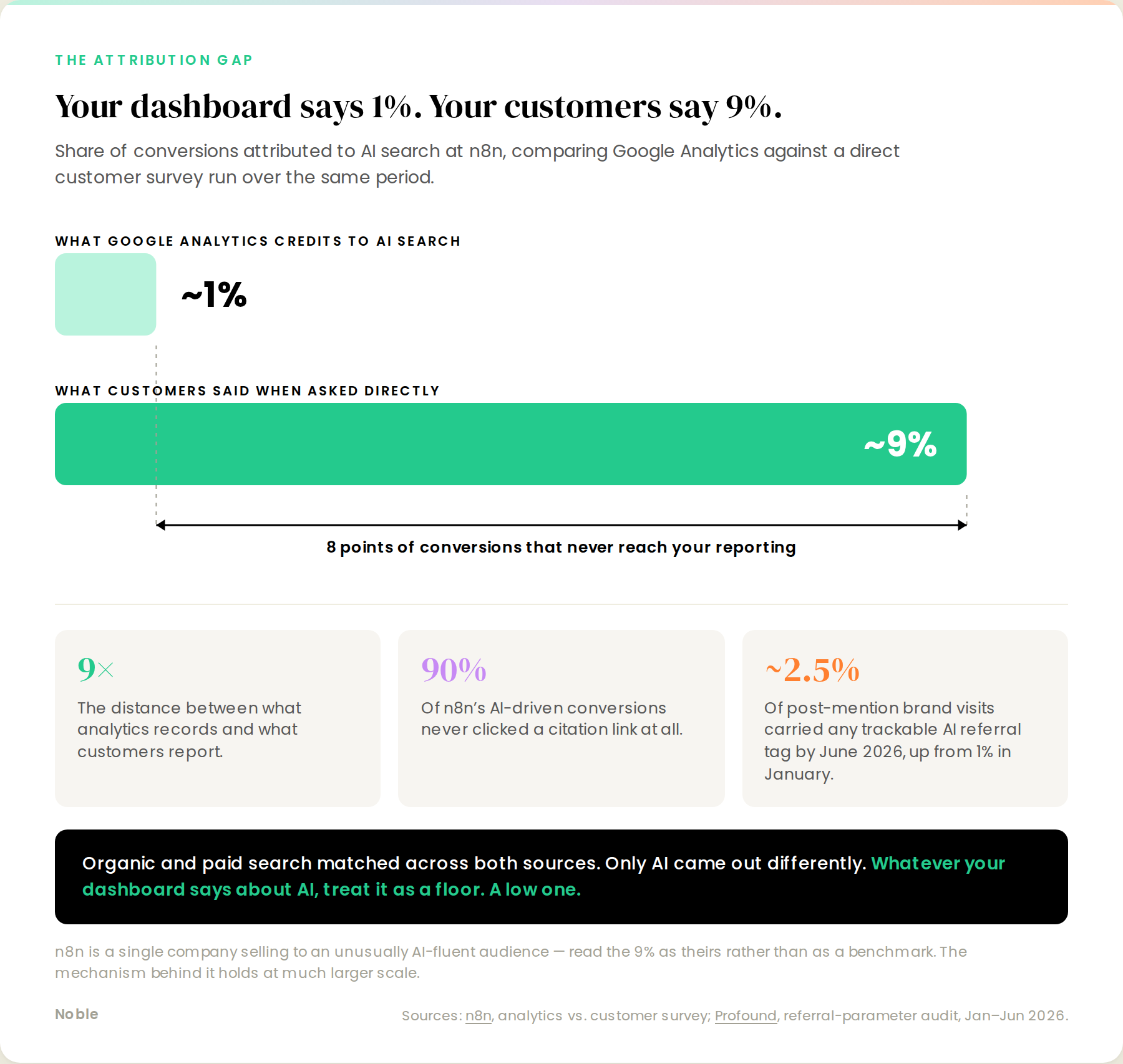
The workflow automation company n8n ran a simple test. They compared what Google Analytics told them about where conversions came from against what customers said when asked directly.
Google Analytics credited AI search with roughly 1% of conversions. But when they ran the numbers in a study with Graphite, it was actually closer to about 9%.
When an AI recommendation resurfaces days later as a branded Google search, that search is what gets recorded. The conversation that started it never enters the file at all. n8n found 90% of their AI-driven conversions never clicked a citation link.
The reason to believe their survey over their analytics is easy to skip past. Organic and paid search showed roughly the same proportions in both sources. Only AI came out differently. If people were simply misremembering how they found n8n, you would expect the survey to disagree with analytics across every channel, not one.
n8n is a single company, and one selling to an unusually AI-fluent audience, so treat their 9% as theirs rather than as a benchmark. The mechanism behind it holds at much larger scale, though.
Profound audited how many post-mention brand visits carried any trackable AI referral parameter across its full panel. From January to April, roughly 1% did. By June, after ChatGPT made its answers more clickable, that had risen to about 2.5%, on partial data.
Which means more than 97% of the visits AI demonstrably influenced arrive carrying nothing your analytics can identify.
Whatever your dashboard currently tells you about AI, treat it as a floor. A low one.
Here’s what these studies can help us assume about how we can tie AI visibility to actual conversions and business outcomes.
Across three independent panels, an AI recommendation produces roughly two additional site visits per hundred people who see it and were not already looking at you. Scrunch measured 2.4 percentage points. Profound measured 2.07 for ChatGPT. Similarweb's brand pairs sit in the same territory.
So for every thousand people who see your brand recommended, expect somewhere around twenty extra visits you would not otherwise have had.
With those 20 extra visits, you can back-calculate:
It is an estimate, but it’s also a great deal better than the near-zero your dashboard currently reports.
Not to mention that we’re applying an average conversion rate to people who are demonstrably not average, since they arrive having already narrowed their options.
That’s the other side of AI attribution. It’s difficult to have a clean number but you can assume that there’s higher intent to buy off of an AI answer after going out of their way to visit your site.
Other than measuring the estimated conversion rate, these studies offer actionable insights that you can implement into your AI Search strategy today.
Those five drastically fix your measurement. Getting recommended in the first place is a different job, and it happens in the third-party content the models read rather than on your own website. That is Noble's work: finding the sources LLMs cite for your category's questions, and getting your brand into them.
GET DISCOVERED ON