All resources

Delia Rowland
Blog
Ask three marketers what a brand mention is and you'll get three answers. One means a hyperlink on a third-party site AI cites. One means being cited by ChatGPT. One means their company name turning up in an AI answer.
That's not a niche problem. In a survey of 343 US marketing decision-makers, half said they'd looked up an AI search term they didn't know after seeing a peer or competitor use it. The vocabulary is moving faster than the shared understanding of it, and it's hard to justify a budget when you don’t know what you’re actually budgeting and why it matters for your AI Search strategy.
So here's each term, what it does, and how they relate.
TL;DR: A backlink points at your page. A citation is a source the AI pulled to build an answer, and usually it belongs to someone else. A brand mention is your name inside the text of that source. Of the three, only the mention changes the words your buyer actually reads.
In this post
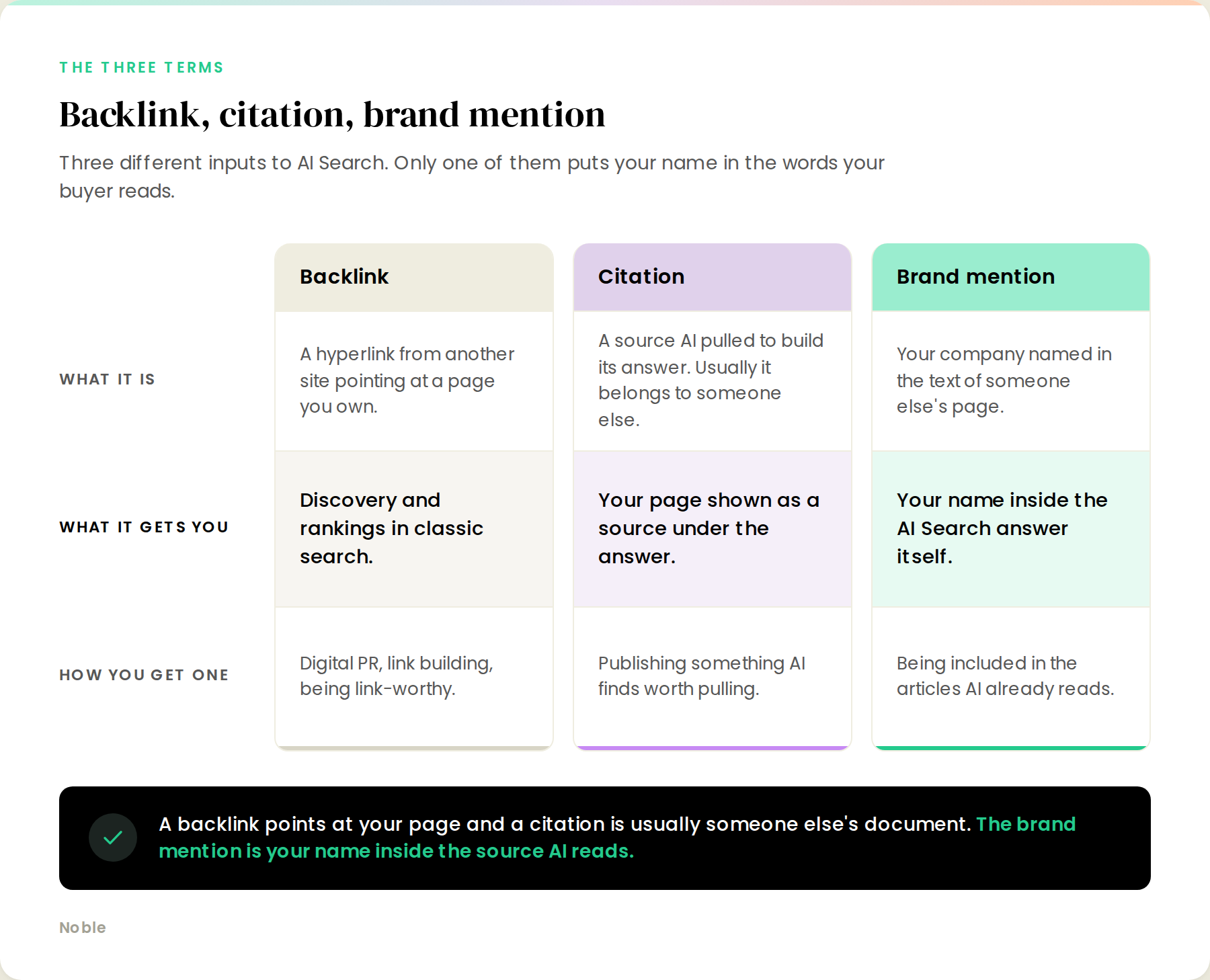
A hyperlink from someone else's website to yours.
Backlinks do two useful jobs: they help search engines find your pages, and they work as a vote of confidence. When credible sites link to you, Google treats your pages as more trustworthy, which helps them rank. That has been the foundation of SEO for two decades and it hasn't stopped being true.
It still helps in AI search too, though indirectly. Semrush and Kevin Indig studied 1,000 domains across five AI platforms and found that sites with stronger, higher-quality link profiles turned up in AI answers noticeably more often. Worth knowing that the effect only really showed up once a site had built real authority. Small, incremental link wins didn't move it.
The same study found that whether a link was tagged nofollow made almost no difference. What helps is the overall picture of a site's authority, not the technical attributes of any single link. Good links make you easier to find, and being findable is a prerequisite for everything else.
Hold onto this: a backlink is about your URL. It points at a page you own.
The source an AI used to build its answer. When ChatGPT answers a question and lists links underneath it, those are citations.
Two things trip people up here.
First, a citation belongs to whoever published that page. If ChatGPT cites a "best CRM tools" roundup, that is a citation for the publisher who wrote the roundup. Not for the eight brands described inside it. That's the usual case rather than the exception: third-party sources account for 85% of brand mentions in AI Search.
Second, a citation is not an endorsement the way a backlink is. Nobody decided to vouch for you. A system picked a document to read.
Hold onto this: a citation is about a document, and usually it's someone else's.
Your company named in the text of someone else's content. The paragraph inside that CRM roundup describing what you do, who you're for, and what you charge.
There’s no hyperlink required for this. What matters is that your name sits in the copy, in context, on a page AI reads when someone asks a relevant question.
Hold onto this: a brand mention is about your name being in a source.
Your name showing up in the AI's answer itself is not one of the three above. It's the result of them.
That's the number people are counting when they talk about tracking AI visibility: how often your brand appears in the answers your buyers actually read. Backlinks, citations, and brand mentions are three inputs. Turning up in the answer is the output.
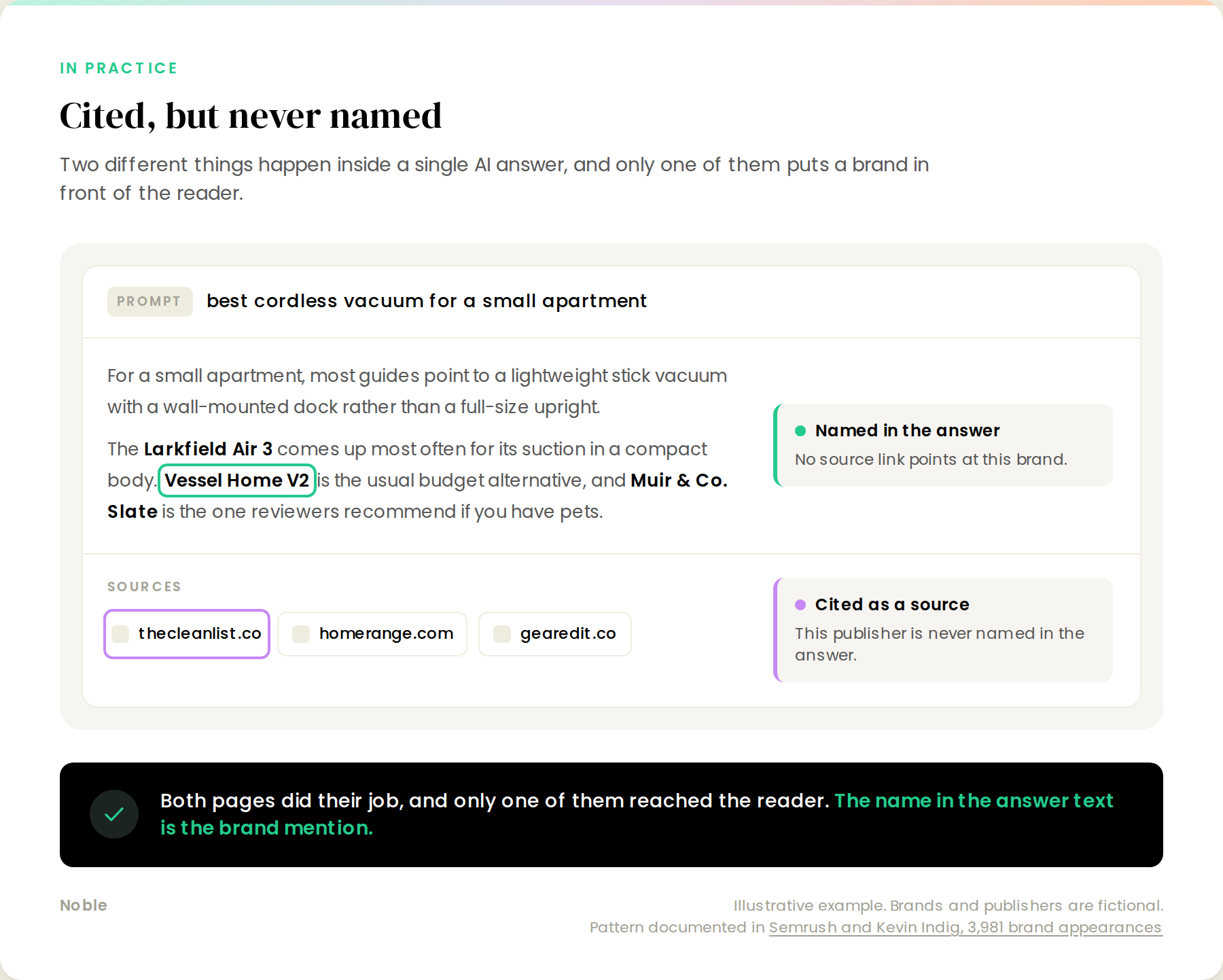
Being cited and being named are not the same event. They come apart in both directions, and one study shows how far.
Semrush and Kevin Indig ran 115 prompts across 14 countries on four AI engines and collected 3,981 brand appearances. For each one they asked two questions. Was the domain cited as a source? And was the brand named in the answer text?
Both the domain being cited as a source and named in the AI answer happened only 13.2% of the time.
The rest split in two directions:
Being read by AI and being recommended by AI are two different outcomes. Most of the time, only one of them happens. Moreover, frequency and value shouldn’t be regarded as the same thing here.
A citation is the system saying a document was relevant. A mention is the system saying a brand is worth naming. And unless the reader clicks into the sources, the only one of those they ever see is the mention.
Two things happen at once when someone asks an AI a question. The model already has a picture of your category from its training data, absorbed long before anyone asked anything. And if search is switched on, it retrieves documents relevant to the question, some of which then get shown as citations. Backlinks do their work in that second lane: pages that rank well in classic search are more likely to get pulled. The answer gets written from both.
That parallel is the likeliest explanation for the 25.1% bucket mentioned above. Those brands got named with no source link because the model didn't need one… it already knew them.
So, there's no list of links inside a language model. A link is simply an instruction a crawler can follow. A name in a sentence is a fact a model can repeat, whether it picked that fact up from a page retrieved today or from everything it read during training.
All three are worth having, but only one of them decides what your buyer actually reads.
Ask what each one actually buys you and the picture becomes clear:
More backlinks get your pages found and ranking in classic search. They help you into the pool AI draws from, but don't decide what the AI answer says about you.
More citations get your page shown as a footnote under the answer. Useful, but still not the same as being recommended in it.
More brand mentions shape what gets said about you in the AI answer itself. This is the only one of the three that changes the words your buyer reads.
Which matters because of where the decision happens. In a Growth Memo study of 185 high-stakes purchase tasks in Google's AI Mode, 74% of participants chose the brand named first in the answer as their top pick, and 64% clicked nothing at all during the task.
If most of your buyers never click, the answer text isn't a route to your website, but rather the whole thing they see. Backlinks and citations get you into the room. The mention is what puts your name in the conversation happening there.
That's why it's worth knowing whether AI is naming you, not just whether it's reading you.
Closing that gap means getting your brand named in the articles AI already reads, not just trying to get into any source. That's the work Noble takes on.
New Mention gets you placed where you're absent, so you show up more often in AI Search: a new, accurate brand mention placed in an article AI already cites for the prompts your buyers search, but where your brand isn't mentioned.
Mention Refresh handles the other direction, fixing what's already there. A correction to an existing brand mention that's inaccurate, out of date, or in an article where your position could be improved.
The citation belongs to the publisher, but the mention inside it is yours.
Proof of concept: Noble's placements contributed to a 250% increase in AI visibility for Avenue Z on their most competitive prompts. More case studies here if you’re interested.
Or check out how our platform works in this 3-minute demo video.
About Noble
Noble helps you show up accurately and often in AI Search. Most of what AI says about a brand comes from third-party sources, and Noble works with publishers to update inaccurate mentions and add new ones in the sources AI cites, so customers discover you in the answers they read.
GET DISCOVERED ON